
Maximizing Photovoltaic Yield: The Calculus of MPPT and Irradiance
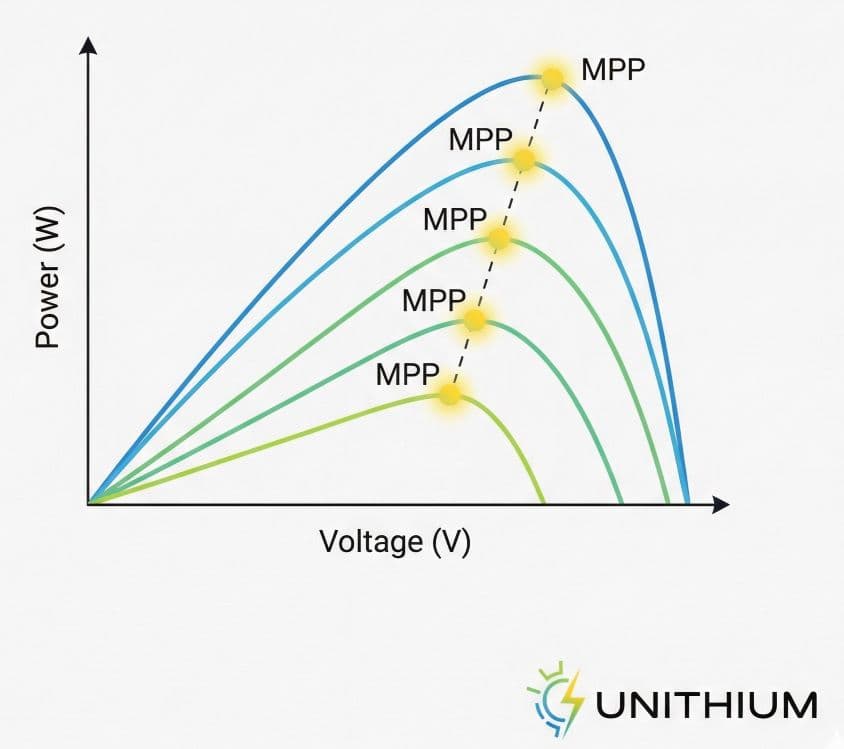
The efficiency of a solar power station is highly dependent on the ability of the inverter to track the Maximum Power Point (MPP) as environmental conditions shift. The P-V characteristic of a solar array is non-linear, requiring sophisticated algorithms to ensure the system operates at the 'knee' of the curve.
At Unithium, we implement 'Perturb and Observe' (P&O) and 'Incremental Conductance' algorithms. The Incremental Conductance method is based on the fact that the derivative of the power () with respect to voltage () is zero at the MPP ():
By solving this differential equation in real-time, the controller can adjust the duty cycle of the DC-DC converter to maintain peak efficiency even during rapid cloud transients.
We also account for 'Global Irradiance' modeling, calculating the Total Solar Radiation () on a tilted surface by summing the beam, diffuse, and reflected components. This mathematical rigor allows us to provide clients with high-confidence 'Energy Yield Forecasts,' ensuring that the deployed system meets the specific energy demand of the industrial load across all seasons.