Edge AI and Predictive Maintenance: Minimizing Industrial Downtime
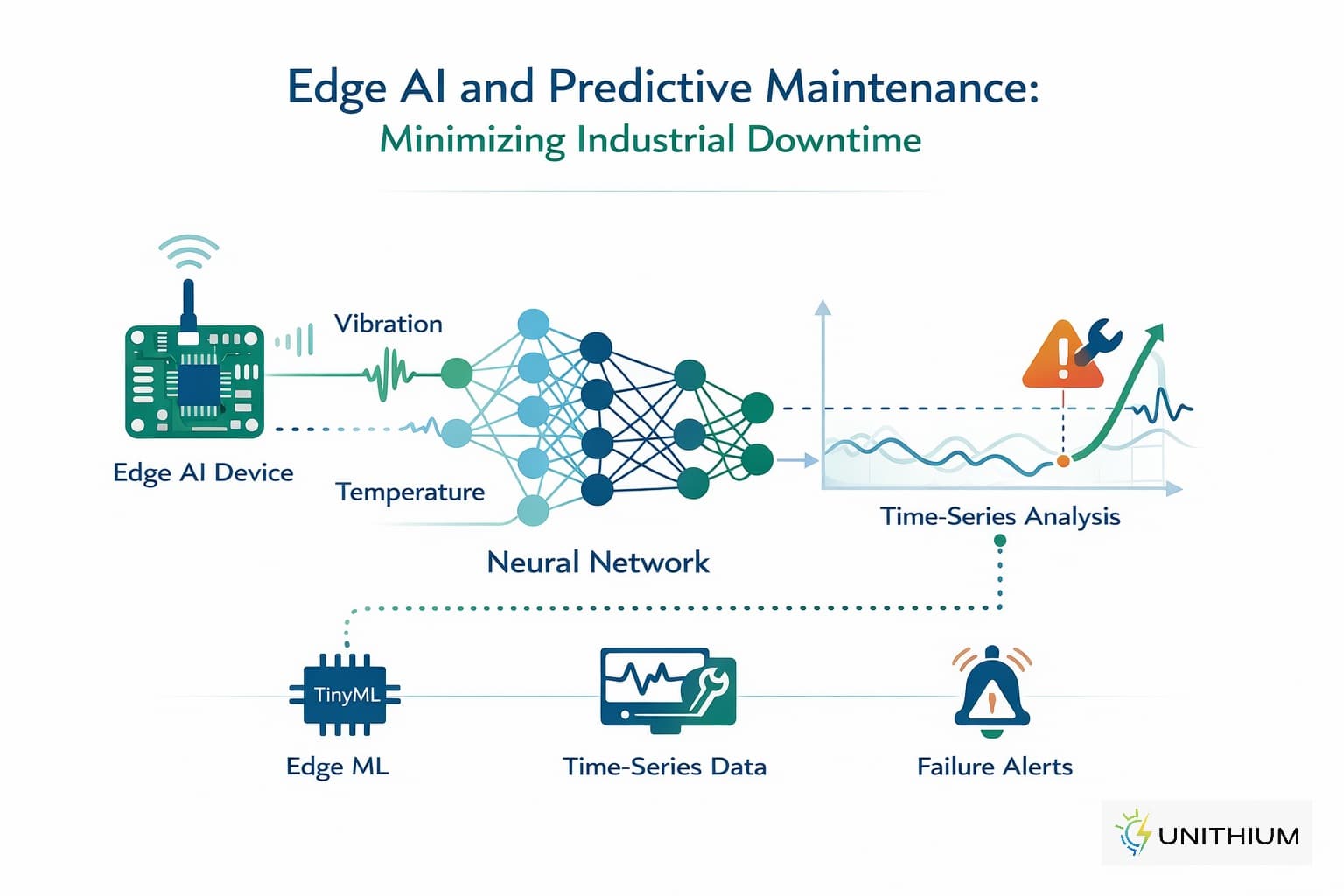
The transition from reactive to predictive maintenance is driven by high-frequency data sampling at the edge. By deploying lightweight neural networks directly on our control hardware, we can analyze vibration, thermal, and harmonic signatures in real-time without the latency of cloud processing.
We utilize Remaining Useful Life (RUL) estimation models based on the health index () of critical components like power capacitors and cooling fans. The degradation of a capacitor, for instance, can be modeled through the increase of its Equivalent Series Resistance (ESR):
Using an LSTM (Long Short-Term Memory) network, we process the time-series data of to predict the timestamp where . This allows for 'Just-in-Time' maintenance, where components are replaced exactly when needed, maximizing the Return on Investment (ROI) of the hardware.
Furthermore, our anomaly detection algorithms utilize autoencoders to identify deviations in the power signature. If the Reconstruction Error () exceeds a calculated threshold , the system flags a potential fault in the inverter's IGBT switching cycle, preventing a catastrophic failure before it propagates through the system.