
Power Quality Engineering: Harmonic Mitigation and Factor Correction
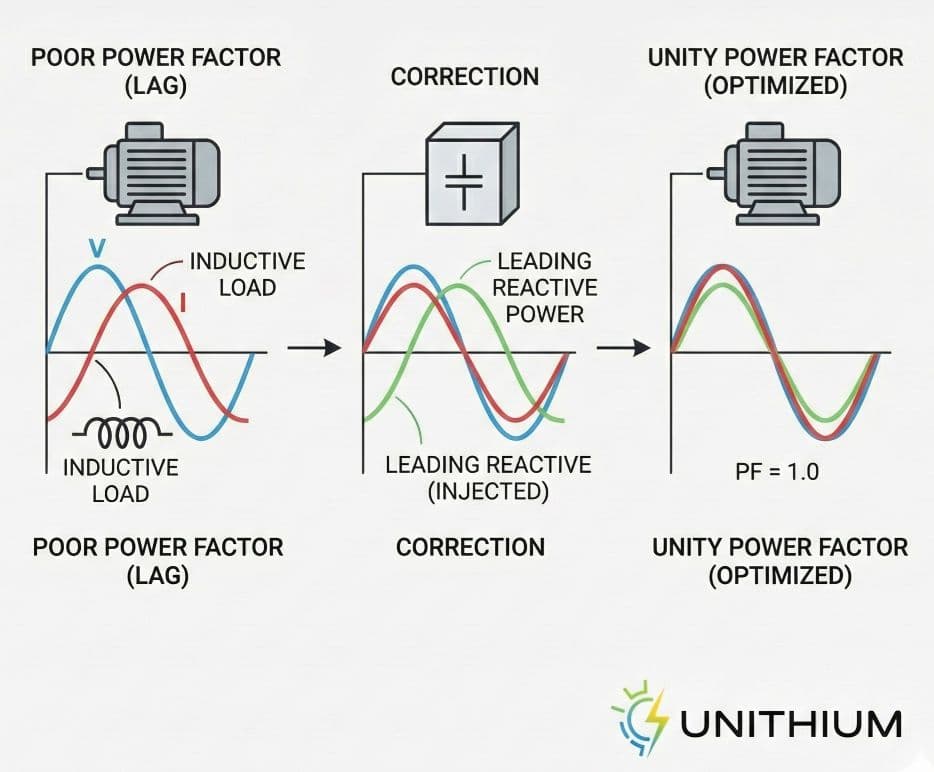
Industrial facilities are often dominated by inductive loads—motors, transformers, and high-intensity lighting—which introduce a phase lag between voltage and current. This results in a poor Power Factor (), leading to increased system losses and utility penalties.
The relationship between Real Power (), Reactive Power (), and Apparent Power () is expressed through the power triangle: . The goal of Unithium's power quality engineering is to bring the Power Factor () as close to unity (1.0) as possible:
By deploying Automated Capacitor Banks or Active Power Filters, we inject leading reactive power to cancel out the inductive lag. This reduces the 'Amperage Draw' for the same amount of 'Work' performed, lowering the thermal stress on conductors and preventing the tripping of overcurrent protection devices.
Additionally, we address Total Harmonic Distortion (THD). Non-linear loads can inject high-frequency harmonics into the system, causing overheating in neutral conductors. We design custom passive and active filters to ensure and , meeting international IEEE 519 standards and ensuring the longevity of sensitive electronic equipment.