
The Mathematics of Reliability: Engineering Resilient Power Systems
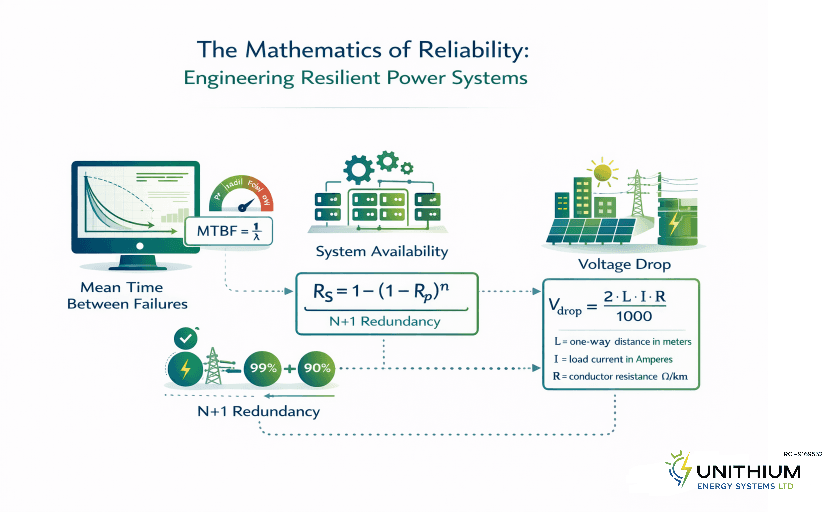
At Unithium, reliability isn't a marketing term; it is a quantifiable engineering metric. To design systems that withstand the volatility of emerging markets, we must model 'System Availability' () and 'Reliability' () using rigorous probabilistic frameworks.
The reliability of a single component is typically modeled using the exponential distribution , where \lambda represents the failure rate (the reciprocal of Mean Time Between Failures, or MTBF). In a series configuration, the failure of one component causes the entire system to fail. However, by engineering parallel redundancy (N+1), we shift the total system reliability () to a significantly higher decimal:
Where is the reliability of an individual power module and is the number of redundant units. For instance, if a single inverter has a 90% reliability over a specific period, adding one redundant unit increases the system reliability to , or 99%.
Beyond uptime, the physics of power delivery must account for conductor impedance and voltage regulation. In industrial settings with long cable runs, the voltage drop () can severely impact equipment efficiency and lifespan. We calculate this using the formula:
Where is the one-way distance in meters, is the load current in Amperes, and is the resistance of the conductor in \Omega/km. Keeping below 3% is our engineering standard to prevent 'brownout' conditions within the internal microgrid.
Finally, we analyze the thermal impact on reliability using the Arrhenius Equation. For every 10°C increase in operating temperature above the rated limit, the chemical degradation rate of battery electrolytes and dry-type capacitors approximately doubles. This makes precise thermal management systems () a non-negotiable component of our design philosophy to ensure the calculated MTBF is met in real-world conditions.