
The Physics of Safety: Mitigating Thermal Runaway in LiFePO4 Systems
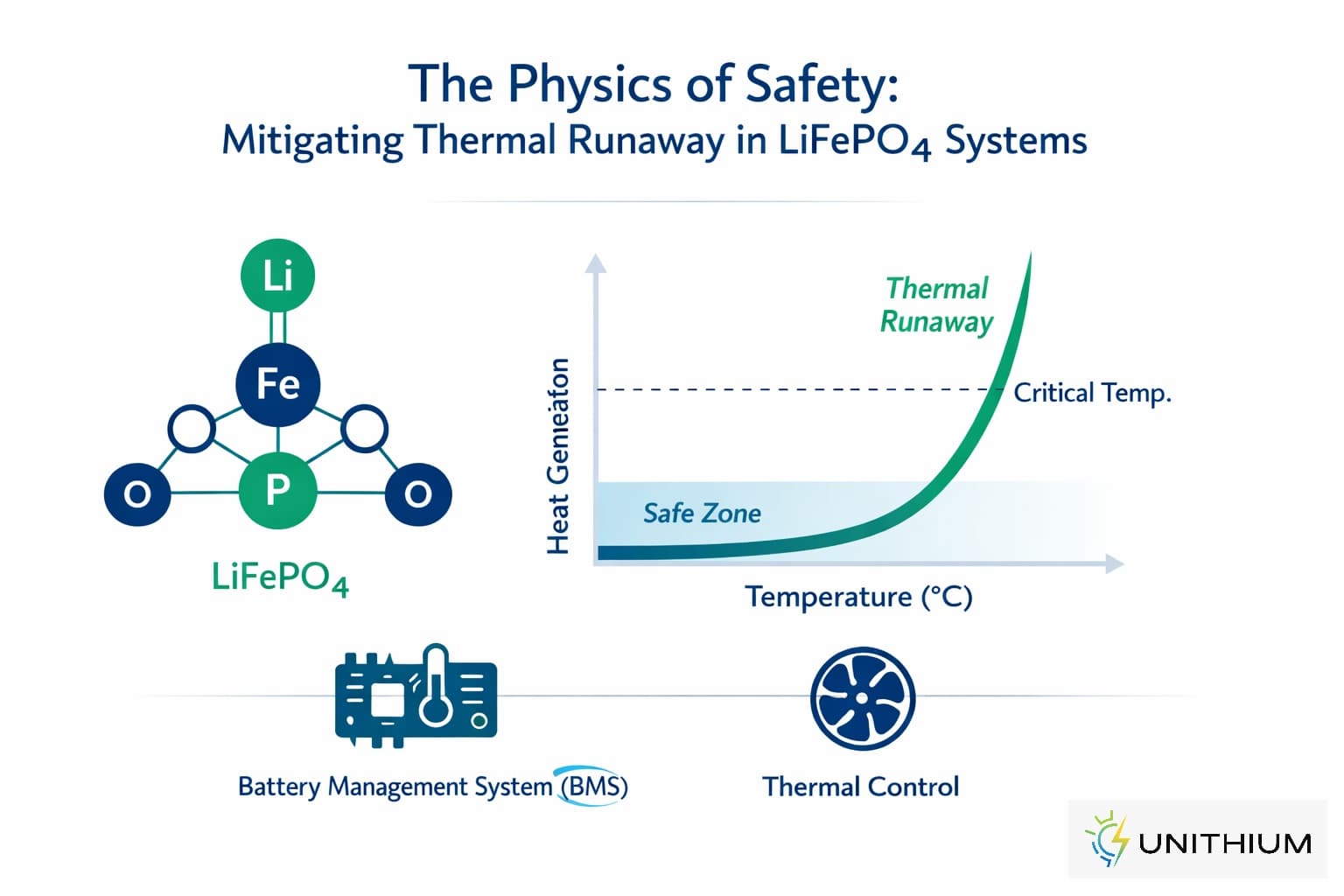
Safety in energy storage is a function of chemical selection and active thermal management. At Unithium, we prioritize Lithium Iron Phosphate (LiFePO4) due to its superior thermal and chemical stability compared to Nickel Manganese Cobalt (NMC) variants. The strong P-O covalent bond in the cathode prevents oxygen release during overcharge, significantly raising the thermal runaway threshold.
The rate of heat generation inside a cell during high-current discharge is governed by Joule heating () and entropic heat. We model the total heat generation () as:
Where is current, is open-circuit voltage, is operating voltage, and is the entropic temperature coefficient. Our engineering objective is to ensure that the heat dissipation rate () always exceeds to prevent localized 'hot spots.'
To manage this, our BMS architecture utilizes a redundant sensing layer. By monitoring the 'Rate of Temperature Rise' (), the system can trigger a hardware-level disconnect before the cell reaches the Critical Temperature (), typically around 270°C for LFP, ensuring an inherently safe operational envelope for industrial deployments.