
The Role of Hybrid Power in Industrial Operations: Engineering for Efficiency
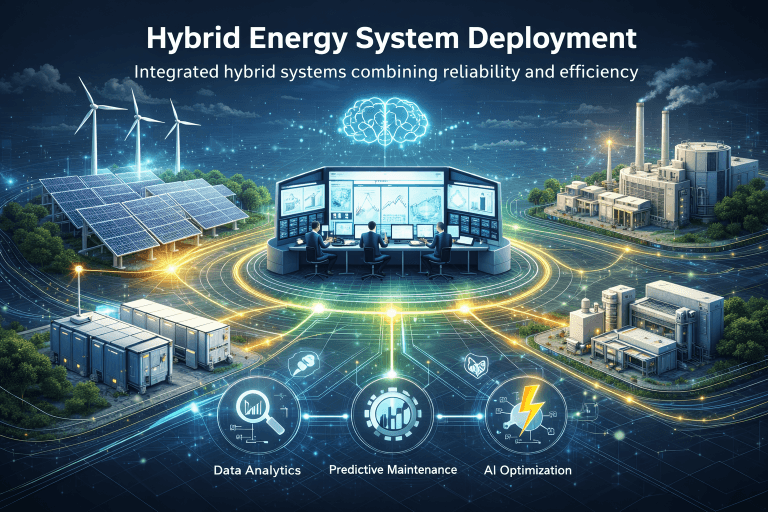
In industrial contexts, hybrid power systems are no longer a luxury but a strategic necessity. A robust hybrid architecture typically integrates Inverter-Based Resources (IBR)—such as Solar PV and Battery Energy Storage Systems (BESS)—with traditional synchronous generation (Diesel or Gas gensets) to create a resilient local microgrid.
The primary engineering objective is the optimization of the Levelized Cost of Energy (LCOE). This is calculated by evaluating the total lifecycle costs () against the total energy generated ():
Where is investment expenditures, is operations and maintenance, is fuel costs, and is the discount rate. By introducing renewable penetration, we aggressively reduce , which is often the most volatile variable in industrial OPEX.
A critical challenge in hybrid systems is the efficiency curve of diesel generators. Generators are most efficient when operating between 60% and 80% of their rated capacity. Operating below 30% leads to 'wet stacking' and high specific fuel consumption (SFC). We utilize BESS to perform 'Peak Shaving' and 'Load Shifting,' ensuring the thermal generator operates strictly within its optimal brake-specific fuel consumption (BSFC) regime.
The mathematical model for fuel consumption is typically a linear or quadratic function of the power output :
Where are engine-specific constants. By integrating a high-speed Microgrid Controller, we can dynamically dispatch BESS power to keep at the point where is minimized, significantly extending the engine's Mean Time Between Overhauls (MTBO).
Furthermore, we address the 'Spinning Reserve' requirement. In traditional setups, a generator must always run at a higher capacity than needed to handle sudden load spikes. In a Unithium-engineered hybrid system, the BESS acts as a virtual spinning reserve with near-zero latency ( response time), allowing the generator to be sized for the base load rather than the peak transients, leading to immediate capital and operational savings.