
Safety by Design: HSE Protocols for High-Voltage Energy Deployments
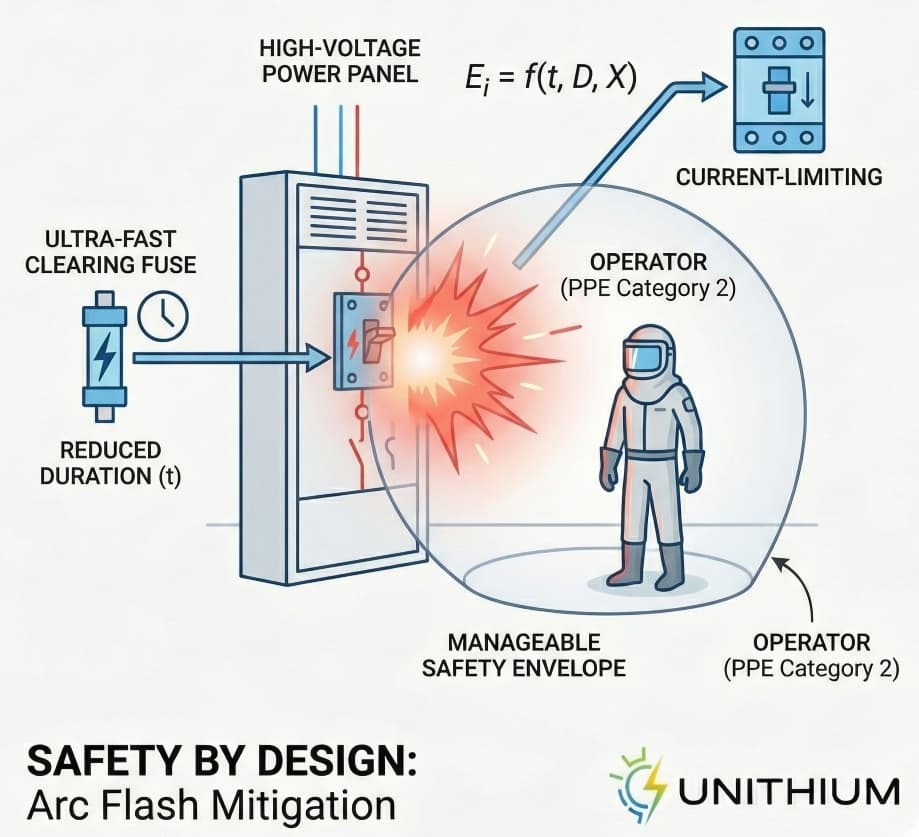
At Unithium Energy Systems, our HSE (Health, Safety, and Environment) framework is integrated directly into the engineering phase, not added as an afterthought. High-voltage energy systems present unique risks, including electrical shock, Arc Flash, and thermal incidents, all of which require a 'Safety by Design' philosophy to mitigate.
The primary technical hazard in high-capacity power stations is the Arc Flash. We model the Incident Energy () at the working distance to determine the appropriate Personal Protective Equipment (PPE) Category. This is calculated using the IEEE 1584 standard:
Where is normalized incident energy and is the arcing time. By utilizing ultra-fast clearing fuses and current-limiting circuit breakers, we reduce the duration of a potential fault, ensuring that our systems remain within a manageable safety envelope for operators.
Operational safety is maintained through strict Lock-Out Tag-Out (LOTO) protocols. Every Unithium unit is engineered with visible-break disconnects and designated earthing points. This ensures that during maintenance, the 'Zero Energy State' can be verified mathematically and physically, preventing accidental re-energization of the DC bus or AC output stages.
Beyond electrical safety, our environmental protocols focus on the containment and lifecycle of hazardous materials. Although LiFePO4 is non-toxic compared to lead-acid, we implement secondary containment systems for large-scale BESS installations to manage potential electrolyte leakage. We also adhere to the 'hierarchy of controls' to eliminate hazards at the source by designing recessed terminals and touch-safe enclosures (IP65 rated or higher).
Finally, our incident management system leverages the AI-driven monitoring built into our units. By logging 'Near-Miss' electrical transients or thermal anomalies, we can perform Root Cause Analysis (RCA) before a safety boundary is breached. This data-driven HSE approach ensures that reliability and safety are two sides of the same engineering coin.