
The Decoupling: The Future of Off-Grid Industrialization in Nigeria
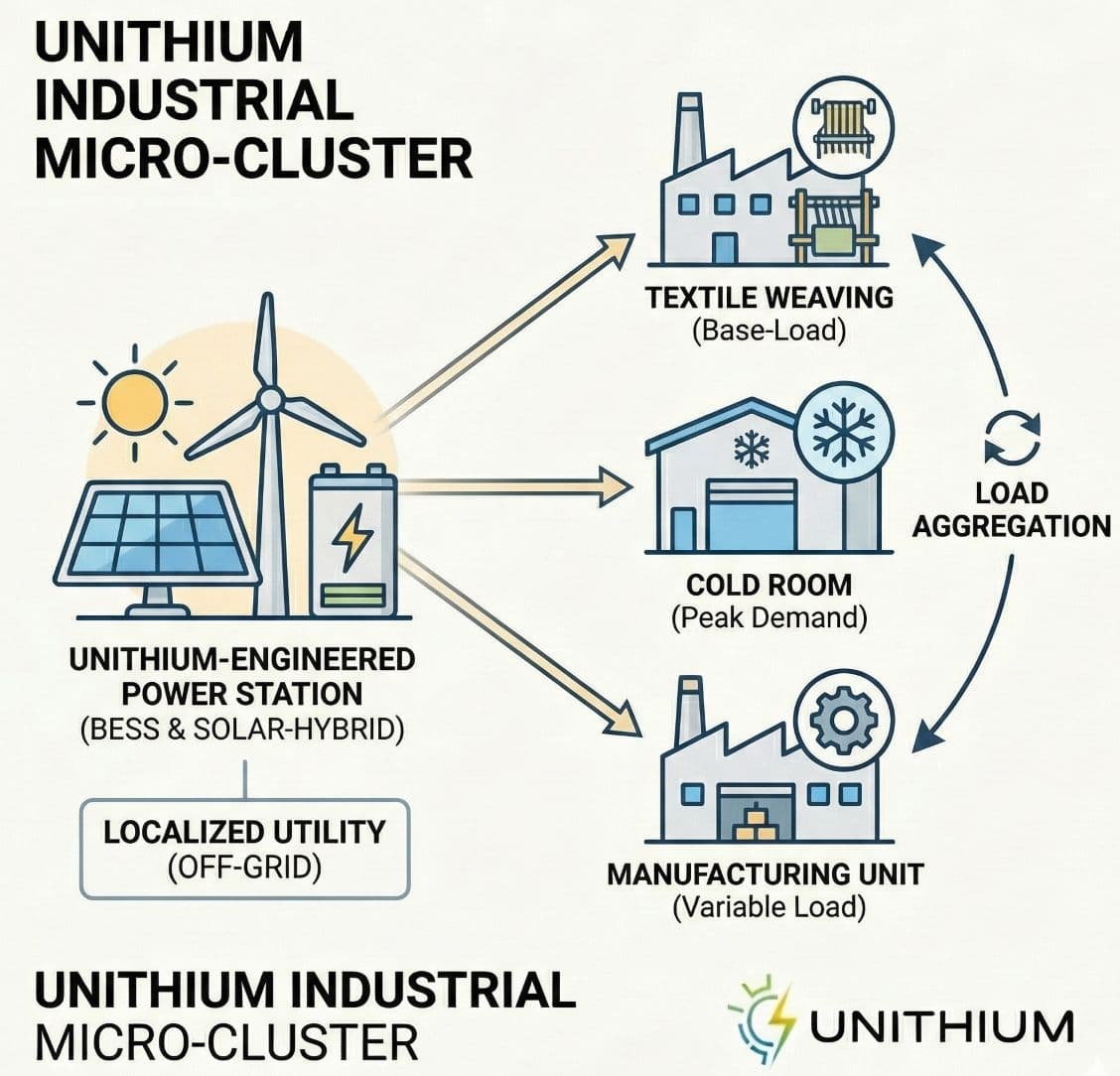
In 2026, the narrative of Nigerian industrialization is shifting from 'waiting for the grid' to 'building the microgrid.' Historically, over 60% of Nigerian manufacturers were forced off-grid due to reliability issues, relying on expensive, carbon-intensive diesel generators. The future of the sector now lies in Decentralized Renewable Energy (DRE) clusters that treat power as a localized utility rather than a centralized hope.
The economics of this shift are driven by the 'Fuel Displacement Ratio.' For an industrial facility, every kilowatt-hour (kWh) generated by solar-hybrid systems represents a direct reduction in the Specific Fuel Consumption (SFC) of thermal backup. We model the potential annual savings () using the differential between the Levelized Cost of Energy (LCOE) of diesel vs. Solar-Hybrid:
With diesel prices remaining volatile, the ROI for industrial-scale LFP (Lithium Iron Phosphate) storage has shortened to under 4 years, making 'Energy-as-a-Service' (EaaS) a viable financial model for the Nigerian real sector.
A key trend is the rise of 'Industrial Micro-Clusters.' Instead of isolated factories, we see the emergence of special economic zones where a central Unithium-engineered power station serves multiple manufacturing units. This allows for 'Load Aggregation,' where the peak demand of one factory (e.g., a cold room) is offset by the base-load of another (e.g., textile weaving), optimizing the total capacity of the BESS (Battery Energy Storage System).
The technical challenge for 2026 remains 'Phase Synchronization' and 'Inertia Management' in 100% renewable microgrids. Without the physical inertia of rotating turbines, these systems must utilize 'Grid-Forming Inverters.' These inverters are engineered to simulate the behavior of synchronous generators, providing the necessary 'Virtual Inertia' to maintain a stable 50Hz frequency during sudden industrial load steps, such as starting a heavy motor.
Ultimately, off-grid industrialization is about sovereignty. By localizing power generation, Nigerian industries can decouple their production costs from national grid collapses and global oil price shocks. At Unithium, we believe that the factory of the future in Lagos, Kano, or Aba will not just be a consumer of energy, but an intelligent, self-sustaining power node within a broader national energy internet.